

Pregnancy Without the Algorithm
What I gained by leaving Instagram during IVF and pregnancy

Welcome to Finding Simcha, where I write personal stories of infertility, motherhood in progress, immigration, and learning to laugh when everything feels wildly out of control. Thanks for reading!

Last August, I deleted my Instagram account as I entered the final phase of IVF treatment. I didn’t post about it or announce I was “taking a break.” I just…deleted my account, the app, and stopped scrolling cold turkey. No farewell tour. No “I’m taking a mental health break.” I logged off with no intention to return.
I’d already seen what infertility and IVF content was served up by the algorithm, so I could already imagine what might be next once our internet overlords knew that I was pregnant and needed 452 opinions on fetal growth before breakfast.
So I said “nope,” left Instagram, and several months later, started writing essays on Substack. (Yes, I realize Substack is another form of social media. That’s not really my point. For me, long-form reading and writing offers far more control than watching a stream of 60‑second “hot takes.” It’s been a game changer because I’m no longer chasing dopamine hits or doomscrolling. Your mileage may vary.)
A few days ago, I came across this post on Substack that captured everything that I was feeling last year. All I could think was: Good for you, Melissa. Congratulations on freeing yourself from the algorithm.
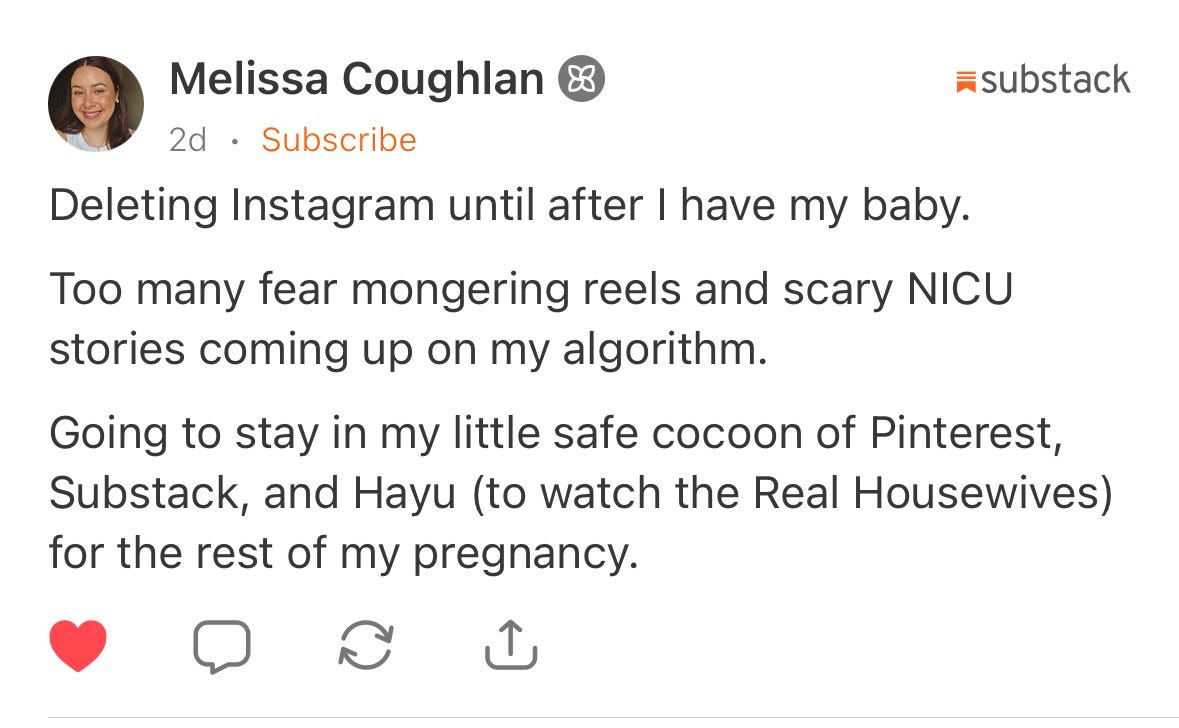
Pregnancy has a way of making every decision feel like a high-stakes version of a Choose Your Own Adventure, except every option ends with someone on the internet telling you picked wrong. I knew that if I stayed online, I wouldn’t just be pregnant. I’d be pregnant while fending off a million different opinions on top of the already vulnerable experience of being newly pregnant in a new country.
I didn’t want my pregnancy (or my fears) to be influenced by strangers, no matter how calm and soothing their voices are, subtly sending judgment in my direction from the glass box in my hand.
Because that’s what social media has become, especially for women in this stage of life. Social media presents itself as a connection across space and time—as a village, as women sharing knowledge with other women–but that’s not really what it feels like in hindsight.
There’s the video that tells you that you’re eating the wrong thing. The post that explains a risk factor that you hadn’t even considered (and almost certainly don’t have). There’s the reel that insists you’re missing something critical. And finally, the woman who is confident that what worked for her is what should work for you, and howdareyouendangeryourbabybydisagreeingwiththisperfectlyreasonablething.
None of it has one iota of nuance, very little of it encourages you to consult your physician, and it’s all framed as the most urgent and important thing you could ever consider. Underneath it all, they’re all sending the same message: you’re probably doing it wrong, and we’re judging you for it. Whatever it actually is.
What makes it worse is that it isn’t accidental. In fact, it’s completely intentional. The algorithm doesn’t reward calm, measured, or evidence-based information. It rewards engagement, and there’s nothing that drives clicks quite like fear.
Fear keeps you watching and scrolling. Fear keeps you clicking on the next video, and the next, and the next.
Many of the loudest voices in the world of pregnancy, motherhood, and parenting aren’t the most qualified; they’re simply the most compelling, the most certain, and sometimes, the most extreme. Much like their expat influencer peers, there’s an entire economy built on capitalizing on your pregnancy and motherhood insecurities. Internet personalities sell sleep guides, feeding programs, and other extremely specific courses that promise the “right” way to do things. Their model relies on convincing you that your perfectly normal experience (like an infant that doesn’t sleep through the night or your slowly healing postpartum body) is actually a problem only their $49 program can fix, preferably before your baby wakes up from his next nap. For a limited time only.
I don’t say this lightly. I say it because once I logged off it became even more obvious.
Without the constant onslaught of information, my anxiety dropped. It didn’t completely evaporate (because I’m still me) but it became less crippling. In all transparency, I still worry, but I stopped spiraling so quickly after scrolling Instagram or a “quick” Google search.
Instead, I seek out trusted voices like my doctors, my doula, and the people who are trained and responsible for my care. I talk to my friends and family who’ve been here before. I talk to the people who really know me, not just a version of me filtered through the internet.
Slowly, I’ve also been able to trust my own intuition more fully.
When there’s less noise, you can actually hear yourself think. I more easily notice what feels off and what doesn’t. I ask better questions. I’m able to understand that a little uncertainty is normal (and okay) without immediately outsourcing it to the internet.
People online love to talk about the “village” when it comes to motherhood. Social media likes to pretend it has replaced that, but your feed of curated advice and viral opinions can’t stand in for real support. Your village isn’t built for the masses. It’s built by those people who answer your texts. It should be made up of people who are actually invested in your well-being, not your likes or clicks.
Leaving social media didn’t make me a better person. It didn’t make me a perfect, serene, anxiety-free pregnant lady, but it did help me strip away a lot of pressure that I didn’t need, and frankly, didn’t ask for.
There is already enough uncertainty in pregnancy. I don’t need an algorithm amplifying it.
First, I am so happy for you and your growing family and hope you are taking good care of yourself.
This is the machine against which I rage, "Many of the loudest voices in the world of pregnancy, motherhood, and parenting aren’t the most qualified; they’re simply the most compelling, the most certain, and sometimes, the most extreme. Much like their expat influencer peers, there’s an entire economy built on capitalizing on your pregnancy and motherhood insecurities"
Expat and life in Europe is better slop capitalizes on exagerrations, promises of a better life, and half-truths. Alone, sad, and worried about your job in small-town Arkansas? MOVE TO FRANCE.
They find the worst examples of the US and compare them to the BEST examples of, say, France. They do this with myths about French parenting too.
I actually think it is harmful because expectant mothers, people struggling in their career, trying to make a positive life change are vulnerable to slop. They deserve better.
Delete the apps. Subscribe to emails and newsletters carefully. Lean on family and friends.
It’s crazy, but I used Instagram back in the first few golden years when literally you ONLY SAW THE PHOTOS OF THE PEOPLE YOU FOLLOWED. That’s it. So if you followed three people you saw their stuff and nothing else. No reels. No stories. No video. It was awesome. I have a dummy account that I log onto once a year when something stupid requires me to communicate in that platform. And in the 90 seconds that I use it, I am reminded why I don’t anymore. Good job, mama! (And yes, I know using substack is a form of the same poison but it seems different somehow.) 🤣🤷🏼♀️