Merry Thursday
A Holiday Note from a Former Grinch

I’ve never had an easy time around the holidays, particularly Christmas. I grew up on the lower end of lower middle class, and I never really had the magical Christmases that my peers did—complete with big family dinners, a visit from Santa, and piles of presents under the Christmas tree.
As a little kid, I’d dutifully send off my Christmas list, filled with the latest toys and gadgets, but never, not once, did I receive anything I wished for. I was confused and often disappointed. My parents encouraged me to dream big; maybe, they said, I’d get something special. But each January, as classmates compared their new N64s and Tamagotchis, all I had to show was a new pair of no-brand Keds from Payless or a sweater from Walmart.
Growing up in a society obsessed with gift-giving and holiday consumerism, I remember being sad that my holidays never looked like what I saw around me or on TV. I genuinely thought it was normal to have a Christmas like the family in Home Alone, traveling with a gaggle of kids to Paris. A girl can dream. And dream she did.
Sometime around 7 years old, I realized Santa wasn’t a jolly old man living in the North Pole. One day I told my mom Santa wasn’t real but was sworn to secrecy to keep the magic alive for my younger sister.
A few years later, my parents discovered what I call “Southern Jesus.” Maybe it was driven by a lack of extra money for frivolous spending at the holidays or genuine religious devotion, but in my house, Southern Jesus Christmas became a celebration of the “true meaning of the season.” Church was central and mandatory. We had a simple dinner. Christmas hymns replaced classics like Santa Baby (no love lost there) and Rocking Around the Christmas Tree. Baby Jesus received three gifts from the wise men, so we did too. There was no extravagance, just the basic things we needed like new socks. I got my first bra for Christmas one year. You get the idea.
Sure, we had a Christmas tree, faithfully decorated the day after Thanksgiving every year, alongside TNT’s 24 hour showing of The Christmas Story, but the real reason for the season was all Baby Jesus, all the time.
As I hit my teens and my relationship with religion grew more complicated, I began to look at Christmas with contempt. And simultaneously the Christmas season seemed to explode everywhere, bleeding earlier and earlier into the calendar year. Target had Christmas decorations available the day after Halloween. Christmas music blared before there was a chill in the air and discounted Reese’s Pumpkins were shelved alongside new Reese’s Christmas Trees. It was a yearly reminder of what I didn’t have. So I leaned into my inner Grinch and for me, the holidays became the least wonderful time of the year.
As an adult, I stopped celebrating Christmas all together. Eventually, in my mid-20s, I started studying Judaism, which only further removed me from feelings of any inclusion during the holidays. I began to celebrate Hanukkah, a minor festival and decidedly not Jewish Christmas. Now in Israel, I work on December 25th because for the majority of the country’s Jewish population, it’s a regular Thursday. Christmas simply isn’t my thing, and that’s okay.
But the sweet irony of it all is that I’ve started appreciating the beauty of the festive season again.
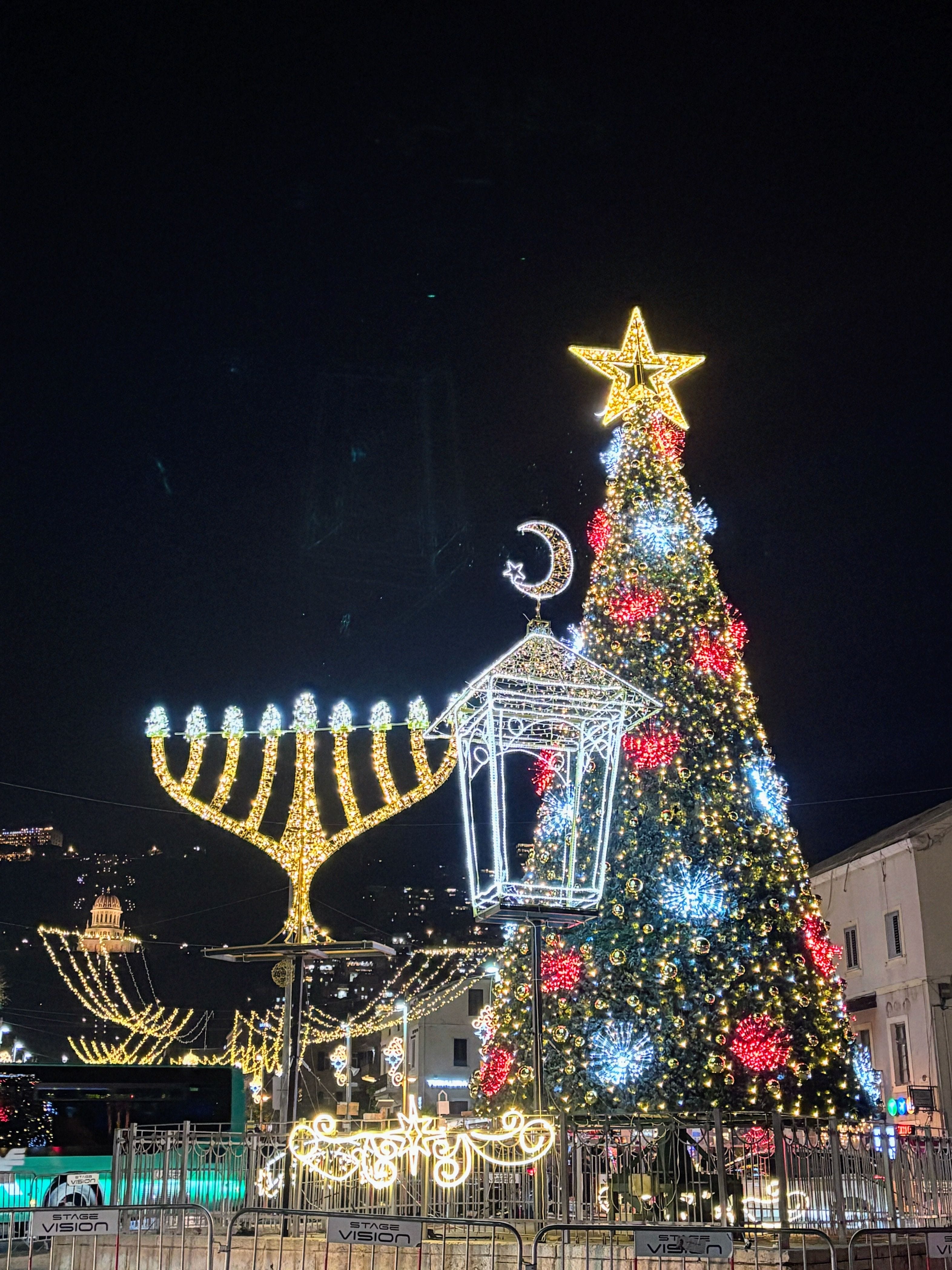
I live in Haifa, one of Israel’s most diverse cities with more than 40% of the population being Christian, Muslim, Druze, or unaffiliated. I also live pretty close to a neighborhood called the German Colony, founded by the Templars in the late 1800s. It’s also the center of Haifa’s Christian life and home to Israel’s largest interfaith holiday celebration: Holiday of Holidays. For more than 30 years, the entire month of December has been filled with sparkling lights, tours, concerts, and kid-friendly events celebrating the magic of the season.
My daily commute takes me through the German Colony every morning and again during the dark, late afternoon. Watching the festivities pass by through the bus’s window somehow, perhaps against my will, began to thaw the chill in my heart. The twinkling of the lights strung across the streets and on churches and the sight of kids running around drinking hot cocoa and visiting candy stands in the holiday market—it’s genuinely lovely. It feels like I’m looking a real Christmas magic, rather than being sold a version of it through endless commercials and gift guides.
This year, my husband and I even went for a walk through the celebration on Christmas Eve. For the first time in a long time, I didn’t resent it. In all honesty, I really enjoyed seeing the kids, sugar-powered and shrieking with excitement for the festivities. I heard animated Hebrew, Arabic, Spanish, English, and Russian. I saw Christians, Muslims, Jews, and Druze sipping mulled wine and apple cider while eating chocolate covered strawberries and deliciously red candied apples. All of us together, somehow, sharing the beauty of the season’s magic.
So, this year, as a former Grinch, I say Merry Christmas if you’re celebrating. And if you’re not, I hope your Thursday is peaceful and kind.
Thank you for this, Heather. I read it with a lot of recognition — and also with some distance.
In my own later life, I’ve unexpectedly found myself surrounded by Christmas again, living now in a small, predominantly Catholic village in Germany, writing about Jewish history. Its a perfect place for writing about my zone of interest.
But despite my long-standing intentions to keep my distance from the season, I discovered that celebrating Chanukkah here recently felt oddly un-Jewish — not hostile, just strangely unmoored.
I’ve always loved Haifa since childhood, for exactly the reasons you describe: its multifaith, multilingual ease. Similarly the Toronto of my yound adulthood, the Toronto I once loved, where multicultural difference felt lived-in rather than staged. I assumed that lighting candles amid church bells and glittering windows would give Chanukkah new resonance for me.
Instead, I found myself realising something quieter and more unsettling: that the surrounding spectacle didn’t deepen the meaning — it merely warmed it. Light, atmosphere, a gentle glow — pleasant, yes. But not necessarily grounding.
Context matters, I’ve learned. Sometimes it gives ritual life. Sometimes it simply decorates it.